Gorilla glass is just one example of the many innovations being deployed to enhance the consumer's experience. Both in the store and in the shopper's hand.
The hardware is resilient and inexpensive. What is lacking?
SX - Shopper Experience.


18.12.09
Long Live the AppStore - Or Not
So, you've invested millions of dollars/euros developing your App Store which still isn't quite up to snuff.
And today you log on to read your favorite shopper relationship blog prepared to pat yourself on the back for how hard you're working to engage your shoppers/customers. And suddenly you begin to worry. Just a bit.
Conventional wisdom says there will be both native apps and OS driven apps but either way the device manufacturers MUST improve upon the way they educate shoppers about their apps.
Recommendation? Go in-store. Go all in.
And today you log on to read your favorite shopper relationship blog prepared to pat yourself on the back for how hard you're working to engage your shoppers/customers. And suddenly you begin to worry. Just a bit.
Conventional wisdom says there will be both native apps and OS driven apps but either way the device manufacturers MUST improve upon the way they educate shoppers about their apps.
Recommendation? Go in-store. Go all in.
17.12.09
Data Visualization In Retail
How do you gauge the activity on your retail floor?
The tools available to software developers are quite diverse and improving at a rapid clip. PODO uses Silverlight to offer a detailed look at the number of shoppers in an area, which consumer electronics devices they are picking up, how long they held them before replacing them on the shelf, pictures & video of customers as they shop, theft and alarm notifications, customer queuing, etc.
The amount of data available to a retailer (or brand) is immense and the tools to display this information are available today.
Are you capable of gathering this information from your retail floor? All it takes in one CPU and a variety of inexpensive sensors to open the floodgates to a treasure trove of data.
The tools available to software developers are quite diverse and improving at a rapid clip. PODO uses Silverlight to offer a detailed look at the number of shoppers in an area, which consumer electronics devices they are picking up, how long they held them before replacing them on the shelf, pictures & video of customers as they shop, theft and alarm notifications, customer queuing, etc.
The amount of data available to a retailer (or brand) is immense and the tools to display this information are available today.
Are you capable of gathering this information from your retail floor? All it takes in one CPU and a variety of inexpensive sensors to open the floodgates to a treasure trove of data.
16.12.09
Smartphones - Decisions, Decisions, Decisions
Every shopper faces this battle.
Companies are cropping up to help users make their decisions since the retailers have been unwilling to take this step.
Podo Technology takes this decision making process into the store.
It's not cheap. It's not easy. But aren't your customers worth the effort? Aren't your competitors' customers worth the effort?
Companies are cropping up to help users make their decisions since the retailers have been unwilling to take this step.
Podo Technology takes this decision making process into the store.
It's not cheap. It's not easy. But aren't your customers worth the effort? Aren't your competitors' customers worth the effort?
McDonald's Continues to Define Shopper Marketing
For the second time in a week I find myself posting about an unexpected source of "The right way to build shopper relationships".
McDonald's will begin offering free WiFi in all of their 14,000 US locations.
So, do you think the nation's road warriors would rather pay $5 for a cup of coffee and pay for internet access or pay $3 and get Wifi for free?
I suspect consumers will speak with their pocketbook.
Well done.
McDonald's will begin offering free WiFi in all of their 14,000 US locations.
So, do you think the nation's road warriors would rather pay $5 for a cup of coffee and pay for internet access or pay $3 and get Wifi for free?
I suspect consumers will speak with their pocketbook.
Well done.
14.12.09
Consumer Electronics Rebounds
Cautious optimism was undoubtedly the reigning attitude headed into this holiday season.
The optimism appears to have been well founded.
The optimism appears to have been well founded.
Got Touchscreens?
Really? You're a modern retailer and you're not investing in interactivity?
If you don't already have screens deployed you're in that safe place where the software has matured and the hardware prices are plummeting.
Now, if you WANT to spend lots of money on your touchscreen here's an option.
45 meters long.
If you don't already have screens deployed you're in that safe place where the software has matured and the hardware prices are plummeting.
Now, if you WANT to spend lots of money on your touchscreen here's an option.
45 meters long.
You Want a Shopper's Attention?
Invest in their loyalty BEFORE they even consider a purchase.
I saw these charger stands regularly while visiting India this Summer. It was one of those semi-regular "Why don't we have these everywhere in the U.S.?" moments.
Today's shopper expects you to add value to their lives. Not attempt to buy their influence.
Who would have thought the day would come when politicians were cheaper than shoppers?
That day is now.
I saw these charger stands regularly while visiting India this Summer. It was one of those semi-regular "Why don't we have these everywhere in the U.S.?" moments.
Today's shopper expects you to add value to their lives. Not attempt to buy their influence.
Who would have thought the day would come when politicians were cheaper than shoppers?
That day is now.
What If Google Decides to Provide Wireless Service?
What do I do if I'm Google and I know one of the most monolithic and slow moving industries in the world will do everything in their power to control my hardware and software?
Do I casually introduce unlocked products which can be used on the carriers' networks?
Or do I take a bold step and introduce my own wireless network?
If I truly want to transform the way people communicate I'd go all in. But then, Google wouldn't admit this even if it were their intention.
So what is the end result of this announcement? Just a little fear and trepidation on the part of the current wireless carriers? Or lose-sleep-at-night-because-your-company-might-be-irrelevant-in-three-years kind of fear?
There is a solution. Leverage your physical presence. Embrace your shoppers. Transform the SX.
If your shoppers were loyal what would be the impact? #1 Churn rates would obviously fall markedly. #2 Perhaps they talk to their friends about their carrier the same way they currently talk about their mobile devices.
Have no doubt that if you do nothing they will leave when given the opportunity. Maybe they leave for Google. Maybe they leave for Comcast. If they are not loyal they will not hesitate to leave.
Do I casually introduce unlocked products which can be used on the carriers' networks?
Or do I take a bold step and introduce my own wireless network?
If I truly want to transform the way people communicate I'd go all in. But then, Google wouldn't admit this even if it were their intention.
So what is the end result of this announcement? Just a little fear and trepidation on the part of the current wireless carriers? Or lose-sleep-at-night-because-your-company-might-be-irrelevant-in-three-years kind of fear?
There is a solution. Leverage your physical presence. Embrace your shoppers. Transform the SX.
If your shoppers were loyal what would be the impact? #1 Churn rates would obviously fall markedly. #2 Perhaps they talk to their friends about their carrier the same way they currently talk about their mobile devices.
Have no doubt that if you do nothing they will leave when given the opportunity. Maybe they leave for Google. Maybe they leave for Comcast. If they are not loyal they will not hesitate to leave.
13.12.09
Socialnomics in Your Store
Your shoppers are radically different than they were just 2 years ago. You'd better stop thinking about next year's ad budget allocation and start thinking about how you're going to prepare your house for the shopper experience tsunami which is about to reach every retailers shore.
Key takeaways:
"Why are we trying to measure social media like a traditional channel anyway?" Erik Qualman
And
"You can't buy attention anymore. Having a huge budget doesn't mean anything in social media... The old paradigm was PAY TO PLAY. Now you get back what you authentically put in. You've got to be willing to PLAY TO PLAY." Alex Bogusky, Co-Chairman, CP&B
Key takeaways:
"Why are we trying to measure social media like a traditional channel anyway?" Erik Qualman
And
"You can't buy attention anymore. Having a huge budget doesn't mean anything in social media... The old paradigm was PAY TO PLAY. Now you get back what you authentically put in. You've got to be willing to PLAY TO PLAY." Alex Bogusky, Co-Chairman, CP&B
12.12.09
Even McDonald's is Investing Heavily in Shopper Experiences
If you're a major consumer electronics brand and you're not spending heavily to embed technology into your shopper's experience you're already falling behind the curve. See attached article.
Proof point #2? When my kids opened their Happy Meals today (yeah, we're that healthy) inside was not the typical somehow-unswallowable plush toy but instead an "Avatar" character. Nothing surprising there except this toy lights up when any sound is emitted near the toy. So, in a $3 meal McDonald's can afford to include a toy with a sound sensor and a battery? McDonald's get it. Do you?
Proof point #2? When my kids opened their Happy Meals today (yeah, we're that healthy) inside was not the typical somehow-unswallowable plush toy but instead an "Avatar" character. Nothing surprising there except this toy lights up when any sound is emitted near the toy. So, in a $3 meal McDonald's can afford to include a toy with a sound sensor and a battery? McDonald's get it. Do you?
Intel Goes Tera - Leaving Poor Giga Behind
48 cores. The impact advances in hardware are going to have on the retail floor are enormous.
"Minority Report" retail experiences can't be too far behind.
"Minority Report" retail experiences can't be too far behind.
11.12.09
Too Big To Quit?
Windows Mobile 7 had better take the world by storm. Apple has set a high bar and it is no longer "good enough" to arrive 5 years late to the party (as MS did in spreadsheets, browsers, etc.)
If Microsoft loses the mobile developers they'll never be relevant. I doubt this will happen - MS can't afford to give up on this game.
If Microsoft loses the mobile developers they'll never be relevant. I doubt this will happen - MS can't afford to give up on this game.
Apple's Soft Underbelly
As enamored as the world seems to be with Apple's AppStore the game obviously isn't over.
Nokia is pulling out all the stops to engage developers to write apps which they hope will draw shoppers to purchase their devices. Apple is tightly controlling their environment (as usual) so Nokia is blowing the doors wide open hoping developer innovation will save their digital bacon. Apple's control-freak nature, while an important component of their success, may also prove to be their undoing.
Assuming Nokia is successful the question remains: How do shoppers, who are unwilling to spend hours scouring the internet to learn about device capabilities and applications decide which product to buy?
At Apple it is quite simple. You effectively have 1 phone option. At Nokia, Samsung, Blackberry, Motorola, etc you have dozens (if not hundreds) of confusing choices.
If you're unwilling to simply your product portfolio you had better be willing to expend the effort necessary to educate consumers about your product. If you don't they'll likely choose to visit The Fruit Stand instead.
Nokia is pulling out all the stops to engage developers to write apps which they hope will draw shoppers to purchase their devices. Apple is tightly controlling their environment (as usual) so Nokia is blowing the doors wide open hoping developer innovation will save their digital bacon. Apple's control-freak nature, while an important component of their success, may also prove to be their undoing.
Assuming Nokia is successful the question remains: How do shoppers, who are unwilling to spend hours scouring the internet to learn about device capabilities and applications decide which product to buy?
At Apple it is quite simple. You effectively have 1 phone option. At Nokia, Samsung, Blackberry, Motorola, etc you have dozens (if not hundreds) of confusing choices.
If you're unwilling to simply your product portfolio you had better be willing to expend the effort necessary to educate consumers about your product. If you don't they'll likely choose to visit The Fruit Stand instead.
10.12.09
The Struggle for Relevance
Nokia's home office appears to be quite focused on transforming themselves into a software and content firm built upon the back of their current device business.
What is lacking? Product education. Their customers simply don't have access to many of their devices in NA retail locations (though they're working to fix this) and when they do see them they're undifferentiated. One would think the world's premier mobile device marketing machine would commit to an inimitable retail experience. They have one of the greatest distribution systems in the world and yet it is not only not being leveraged but with the closing of their flagship stores their presence is even being marginalized.
In my typical less-than-humble opinion Nokia needs to use current marketing technologies (i.e. a platform such as Podo Technology's) to better educate their potential customers about their offerings.
Fear in retail plays an enormous role in a shopper's purchase decision. If they don't understand your devices they will NOT buy them. Nokia is huge but North American shoppers simply do not know them.
How much is a relationship worth?
What is lacking? Product education. Their customers simply don't have access to many of their devices in NA retail locations (though they're working to fix this) and when they do see them they're undifferentiated. One would think the world's premier mobile device marketing machine would commit to an inimitable retail experience. They have one of the greatest distribution systems in the world and yet it is not only not being leveraged but with the closing of their flagship stores their presence is even being marginalized.
In my typical less-than-humble opinion Nokia needs to use current marketing technologies (i.e. a platform such as Podo Technology's) to better educate their potential customers about their offerings.
Fear in retail plays an enormous role in a shopper's purchase decision. If they don't understand your devices they will NOT buy them. Nokia is huge but North American shoppers simply do not know them.
How much is a relationship worth?
3.12.09
Nokia Sticks to Symbian Platform
I wonder if Nokia is afraid. It is very easy to strut proudly around the world and boast incessantly about your 40%+ market share.
Motorola used to do that. They now have 7%.
Interesting side note? I'm beginning to see more and more articles focusing on Mobile OS market share and ignoring the device manufacturer altogether.
What does this tell us? All manufacturers should be afraid. Be very afraid.
Motorola used to do that. They now have 7%.
Interesting side note? I'm beginning to see more and more articles focusing on Mobile OS market share and ignoring the device manufacturer altogether.
What does this tell us? All manufacturers should be afraid. Be very afraid.
1.12.09
Online Search is Only Going To Get Better
Retailers have one last bastion of opportunity. It is there. They own it. It is begging to be used. It is their building.
And yet most of the industry continues pandering to the POP advertising crowd and co-marketing with the brands because they don't have the vision necessary to take control of their own marketing destiny.
Tomorrow your shopper's are going to have tools like Google Squared in their hands while in your store. You'd better hope you have SOMETHING engaging in-store to make them want to visit you rather than your competition.
If this opportunity is missed retail will continue down its current path toward irrelevance where "geographic convenience" is the only factor which enters a shopper's mind.
Is it fun to shop in your stores?
And yet most of the industry continues pandering to the POP advertising crowd and co-marketing with the brands because they don't have the vision necessary to take control of their own marketing destiny.
Tomorrow your shopper's are going to have tools like Google Squared in their hands while in your store. You'd better hope you have SOMETHING engaging in-store to make them want to visit you rather than your competition.
If this opportunity is missed retail will continue down its current path toward irrelevance where "geographic convenience" is the only factor which enters a shopper's mind.
Is it fun to shop in your stores?
And You Thought Wireless Devices Were Already Pervasive...
We're all familiar with NFC (Near Field Communication) but Sony is finalizing/perfecting their "Transfer Jet" technology as well.
The ability for wireless devices to communicate at high speeds is going to substantially improve the functionality of every gizmo bearing one of these chips.
A time is coming when all your devices will finally communicate with one another.
Is your Retail Floor going to be ready to communicate with the devices your shoppers are carrying?
The ability for wireless devices to communicate at high speeds is going to substantially improve the functionality of every gizmo bearing one of these chips.
A time is coming when all your devices will finally communicate with one another.
Is your Retail Floor going to be ready to communicate with the devices your shoppers are carrying?
30.11.09
Your customers WILL Yelp!
In 2005 customers were arriving at retail locations better informed about their target purchases than the sales staffers trying to help them by doing pre-trip research. (Which triggers fear and dread in a sales staff.)
Fast forward to 2009. Not only are shoppers better informed but they're also ready to JUDGE your retail performance.
"Word of mouth" is going viral and the world of retail is not ready for the backlash.
Did you have the product in stock?
Was it easy to locate?
Was it hard to find a human being helper?
Did I have FUN while shopping here and accomplish my goals?!
Retailers: Your shoppers ARE going to rate you via Yelp, CitySearch, etc. Are you sure you're providing them with the best shopping experience possible? Really?
Fast forward to 2009. Not only are shoppers better informed but they're also ready to JUDGE your retail performance.
"Word of mouth" is going viral and the world of retail is not ready for the backlash.
Did you have the product in stock?
Was it easy to locate?
Was it hard to find a human being helper?
Did I have FUN while shopping here and accomplish my goals?!
Retailers: Your shoppers ARE going to rate you via Yelp, CitySearch, etc. Are you sure you're providing them with the best shopping experience possible? Really?
25.11.09
In-store Humor
Grandad was reminiscing about the good old days....................
"When I were a lad, Momma would send me down to t'corner store wi' a
dollar,.... and I'd come back wi' five pounds o' potatoes, two loaves o'
bread, three pints o' milk, a pound o' cheese, a packet o' tea, an' 'alf
a dozen eggs.
Yer can't do that nowadays.
Too many doggone security cameras."
You think security cameras are everywhere in the U.S.A.? Visit London.
10 years from now Big Brother (and his 10,000 loosely associated siblings) are going to be watching virtually every move we make in public.
Watching how people act and react in a store is invaluable to improving their shopping experience. If someone frowns every time they walk past the "Dried Prunes Tasting Table" perhaps you should consider an alternative display.
Data is worthless unless it can be gather and analyzed. How well do you really know your store?
"When I were a lad, Momma would send me down to t'corner store wi' a
dollar,.... and I'd come back wi' five pounds o' potatoes, two loaves o'
bread, three pints o' milk, a pound o' cheese, a packet o' tea, an' 'alf
a dozen eggs.
Yer can't do that nowadays.
Too many doggone security cameras."
You think security cameras are everywhere in the U.S.A.? Visit London.
10 years from now Big Brother (and his 10,000 loosely associated siblings) are going to be watching virtually every move we make in public.
Watching how people act and react in a store is invaluable to improving their shopping experience. If someone frowns every time they walk past the "Dried Prunes Tasting Table" perhaps you should consider an alternative display.
Data is worthless unless it can be gather and analyzed. How well do you really know your store?
24.11.09
Every detail matters to SOME shoppers
Take advantage of EVERY opportunity possible to engage people in your stores.
This firm wants you to smile when you look at their bar code designs. Is that too much to ask?
Are there any retailers or brands which are truly focused on finding ways to make shoppers happy? Or do they just want your money?
A prostitute just wants your money. A spouse wants a relationship. Which one best describes retail relationships with your shoppers?
Leave no square inch unturned.
This firm wants you to smile when you look at their bar code designs. Is that too much to ask?
Are there any retailers or brands which are truly focused on finding ways to make shoppers happy? Or do they just want your money?
A prostitute just wants your money. A spouse wants a relationship. Which one best describes retail relationships with your shoppers?
Leave no square inch unturned.
23.11.09
How to Not Share Information
Anyone creative can destroy information but it takes considerably more effort and planning to publish exactly the right data when and where it is needed. (And it CANNOT be done properly in flyers and circulars and POP.) Data is living - it cannot be relegated to a 7 / 14 / 30 days cycle of printed material.
Is this video indicative of what retailers do with product information when it's received from product manufacturers? Perhaps it's not treated this harshly but dormant data is just as useless as digested data.
Is this video indicative of what retailers do with product information when it's received from product manufacturers? Perhaps it's not treated this harshly but dormant data is just as useless as digested data.
22.11.09
In-store and Online Converge
"Look books". Yet another term to describe the transforming shopper...
You cannot stop communicating with your shopper altogether but you'd certainly better be listening to HOW they are willing to receive information.
Fragmentation is here. Even the J.C. Penney's is throwing in the towel and shifting to specialty catalogs specific to the shoppers whims.
Now, if Penney's DM campaigns can accurately target their increasingly fragmented audience with specialty catalogs what is stopping them (or any other retailer) from transferring their knowledge of their customers into the store?
Analogy: If it were your job to convince someone to vote for a political candidate would you push this soon-to-be-liar in print and television but leave out radio? (Bear with me. I know all these mediums are dying.) Of course not. You'd attack all mediums with gusto and focus on the one or two which provide the most bang for your influence-buying buck.
Retailers: Shoppers have CHOSEN to visit you in your home. How welcome are you making them feel? Are you greeting them by name? It is possible today. Are you inviting their presence with digital coupons? It is possible today.
Where is your marketing budget headed? You know TV and print are losing relevancy but you're not sure where to shift your efforts? Go all in. To your store. Your store is your greatest asset. It can be the ultimate destination. Or it can be a necessary evil. Make it the greatest shopping environment and experience you possibly can and your shoppers WILL tell their friends.
You cannot stop communicating with your shopper altogether but you'd certainly better be listening to HOW they are willing to receive information.
Fragmentation is here. Even the J.C. Penney's is throwing in the towel and shifting to specialty catalogs specific to the shoppers whims.
Now, if Penney's DM campaigns can accurately target their increasingly fragmented audience with specialty catalogs what is stopping them (or any other retailer) from transferring their knowledge of their customers into the store?
Analogy: If it were your job to convince someone to vote for a political candidate would you push this soon-to-be-liar in print and television but leave out radio? (Bear with me. I know all these mediums are dying.) Of course not. You'd attack all mediums with gusto and focus on the one or two which provide the most bang for your influence-buying buck.
Retailers: Shoppers have CHOSEN to visit you in your home. How welcome are you making them feel? Are you greeting them by name? It is possible today. Are you inviting their presence with digital coupons? It is possible today.
Where is your marketing budget headed? You know TV and print are losing relevancy but you're not sure where to shift your efforts? Go all in. To your store. Your store is your greatest asset. It can be the ultimate destination. Or it can be a necessary evil. Make it the greatest shopping environment and experience you possibly can and your shoppers WILL tell their friends.
19.11.09
The Future of Data Analysis
Everyone likes to beat up on Microsoft (IBM was the punching bag in the 90's) but they are coming out with some truly incredible technologies/tools.
Microsoft Pivot, while still just an experiment, shows a vision of what data analysis could be.
Podo is already embracing some existing tools to distribute our customer's analytic data (via MS Analysis Services and Silverlight) which allows our stakeholders to browse near real-time data in the comfort of an Excel spreadsheet or a web browser Dashboard.
15 years ago I was thoroughly frustrated with the near impossibility of gaining access to my company's data. Today it is possible but still painful for the average guy.
Tomorrow? The only question is "How would you like your data? Big, Huge or Supersize?"
Microsoft Pivot, while still just an experiment, shows a vision of what data analysis could be.
Podo is already embracing some existing tools to distribute our customer's analytic data (via MS Analysis Services and Silverlight) which allows our stakeholders to browse near real-time data in the comfort of an Excel spreadsheet or a web browser Dashboard.
15 years ago I was thoroughly frustrated with the near impossibility of gaining access to my company's data. Today it is possible but still painful for the average guy.
Tomorrow? The only question is "How would you like your data? Big, Huge or Supersize?"
Driving In-store Traffic
Retailers have spent decades driving traffic to stores via television, print and radio. Everyone sees the landscape shifting (or upheaving if you're in the newspaper business) but few people truly understand where they should be headed.
The companies (such as Placecast) who can use today's access point (mobile devices rather than television sets) to drive store traffic are going to be the winners.
If you're not already exploring a service like Placecast you should be.
Now, the question begs: What happens when you get them to your store? Is the SX (shopper experience) far below the shopper's expectations?
How to ponder what your shopper experience SHOULD be? Turn on your Xbox or PS3 and and watch the intro to any leading game. Breathtaking, eh?
Shopping COULD be this majestic.
It is simple really: Lead, follow or get cleaned up by the road crew.
The companies (such as Placecast) who can use today's access point (mobile devices rather than television sets) to drive store traffic are going to be the winners.
If you're not already exploring a service like Placecast you should be.
Now, the question begs: What happens when you get them to your store? Is the SX (shopper experience) far below the shopper's expectations?
How to ponder what your shopper experience SHOULD be? Turn on your Xbox or PS3 and and watch the intro to any leading game. Breathtaking, eh?
Shopping COULD be this majestic.
It is simple really: Lead, follow or get cleaned up by the road crew.
Location, location, location...
Takeaway from attached article:
"The truth is that social networking, while great in many respects, does not fulfill a fundamental human desire: To be in the actual presence of other people."
What is the retailer's greatest asset? Their building. People LIKE to shop. They like to do things with their friends. They like to meet new people. They like to live life. Real life. Not Facebook life.
Retailers MUST get over their insecurities (brought on by the internet bubble of the late 90's) and EMBRACE their brick-and-mortar-ness. Having a physical location is a retailer's greatest asset.
Reality? This asset is not being fully utilized. I would dare to say it is barely being utilized.
My family and I are going to Disney World next month. Is it because we want to visit Orlando, FL? Of course not. It is because of the experience which awaits us there.
Now, you cannot afford to make your retail experience a mini-Disney-World but you can do better than a big box stuffed w/ goods and easy to ignore POP.
The shopper UX is being overhauled. Now. When are going to take your first steps?
"The truth is that social networking, while great in many respects, does not fulfill a fundamental human desire: To be in the actual presence of other people."
What is the retailer's greatest asset? Their building. People LIKE to shop. They like to do things with their friends. They like to meet new people. They like to live life. Real life. Not Facebook life.
Retailers MUST get over their insecurities (brought on by the internet bubble of the late 90's) and EMBRACE their brick-and-mortar-ness. Having a physical location is a retailer's greatest asset.
Reality? This asset is not being fully utilized. I would dare to say it is barely being utilized.
My family and I are going to Disney World next month. Is it because we want to visit Orlando, FL? Of course not. It is because of the experience which awaits us there.
Now, you cannot afford to make your retail experience a mini-Disney-World but you can do better than a big box stuffed w/ goods and easy to ignore POP.
The shopper UX is being overhauled. Now. When are going to take your first steps?
Seth Godin - TV Industrial Complex Has Been Canceled
This insightful talk which was produced over 2 1/2 years ago (be forewarned - it's 18 minutes long) had two key concepts.
1) Television is dead.
2) The ONLY way to capture the attention and drive adoption of your products is to focus on passionate buyers of your products. Innovators and Early Adopters are the only groups you should focus on.
You MUST take risks. You MUST do something DIFFERENT (and in Seth's words, REMARKABLE - not in the sense of "neat" but something which triggers a remark from one shopper to another.)
2 1/2 years. Scores of products have come and gone over this period of time (especially in the fast-paced world of mobile devices) and yet what has changed? Very little due to an ingrained pattern of risk aversion by the major brands and their gatekeepers / agencies.
It's time. Let's make shopping fun again. So people will talk. Everyone talks. But the question is: Are they going to tell their friends about their trip to the wireless phone store or street vendor playing the guitar in his underwear?
The Naked Cowboy is remarkable. Are you?
1) Television is dead.
2) The ONLY way to capture the attention and drive adoption of your products is to focus on passionate buyers of your products. Innovators and Early Adopters are the only groups you should focus on.
You MUST take risks. You MUST do something DIFFERENT (and in Seth's words, REMARKABLE - not in the sense of "neat" but something which triggers a remark from one shopper to another.)
2 1/2 years. Scores of products have come and gone over this period of time (especially in the fast-paced world of mobile devices) and yet what has changed? Very little due to an ingrained pattern of risk aversion by the major brands and their gatekeepers / agencies.
It's time. Let's make shopping fun again. So people will talk. Everyone talks. But the question is: Are they going to tell their friends about their trip to the wireless phone store or street vendor playing the guitar in his underwear?
The Naked Cowboy is remarkable. Are you?
18.11.09
Why Isn't Your In-Store Experience Something Like This?
Is there any reason you aren't producing and distributing material such as this to your retail outlets?
The creativity certainly exists (as seen in this incredible 3D modeling rendering.)
You simply need a pipeline to your retail floor so you can distribute this creativity.
Don't ask your agency about in-store engagement. Every agency claims an interactive division but none of them differentiate between retail stores and the internet. The difference is vast.
The creativity certainly exists (as seen in this incredible 3D modeling rendering.)
You simply need a pipeline to your retail floor so you can distribute this creativity.
Don't ask your agency about in-store engagement. Every agency claims an interactive division but none of them differentiate between retail stores and the internet. The difference is vast.
The Sensors Are Coming
If sensors can be added to detect wet diapers how easily might they be integrated into retail environments?
Podo is already incorporating motion sensing, security cameras, temperature sensors, sound sensors, etc into our solution.
The more you know about your shoppers the better you'll relate to them when they attempt to communicate with you.
Sensors are only the beginning.
Podo is already incorporating motion sensing, security cameras, temperature sensors, sound sensors, etc into our solution.
The more you know about your shoppers the better you'll relate to them when they attempt to communicate with you.
Sensors are only the beginning.
How Much Does Ease of Use Matter?
The Apple iPhone. Nonexistent 5 years ago and now it is tearing down companies and product lines around the globe.
Windows Mobile and Symbian badly want to beat Apple.
Is it possible? Undoubtedly. Despite the fact that the iPhone rules the media outlets the iPhone itself is a pretty weak phone and email communicator.
But the device's ease of use is driving people to use smartphones for the first time.
Oh, and note the comment about "Apple's retail presence". Who has a retail experience anything like Apple? No one.
Does anyone else remember when Apple was ripped for even considering opening retail locations?
This is the investment Apple was willing to make in order to connect with and communicate with their shoppers.
What has your firm done? More POP? More television commercials? Please.
Windows Mobile and Symbian badly want to beat Apple.
Is it possible? Undoubtedly. Despite the fact that the iPhone rules the media outlets the iPhone itself is a pretty weak phone and email communicator.
But the device's ease of use is driving people to use smartphones for the first time.
Oh, and note the comment about "Apple's retail presence". Who has a retail experience anything like Apple? No one.
Does anyone else remember when Apple was ripped for even considering opening retail locations?
This is the investment Apple was willing to make in order to connect with and communicate with their shoppers.
What has your firm done? More POP? More television commercials? Please.
In-store Comparison Shopping
When shoppers can read customer reviews, compare prices and even check competitor inventory levels what is going to make them desire a visit to your retail establishment?
Time is running out for retailers.
The opportunity to establish relationships with your shoppers is now but the window is closing.
Retail has a choice: Do I want to become a commoditized distraction or do I want to to build relationships with my shoppers so they'll WANT to visit my store?
Regaining the trust of shoppers it is going to be expensive. And painful. And difficult. And it is a never-ending process. But those who DO commit will be rewarded.
Time is running out for retailers.
The opportunity to establish relationships with your shoppers is now but the window is closing.
Retail has a choice: Do I want to become a commoditized distraction or do I want to to build relationships with my shoppers so they'll WANT to visit my store?
Regaining the trust of shoppers it is going to be expensive. And painful. And difficult. And it is a never-ending process. But those who DO commit will be rewarded.
The Cloud in Retail
Life without the cloud was difficult, expensive and frequently next to impossible.
If your business isn't embracing the cloud already it should be on your research list.
It's working for PODO Technology right now.
If your business isn't embracing the cloud already it should be on your research list.
It's working for PODO Technology right now.
Hammertime or Listen Time???
Many thanks to XKCD link HERE. Takeaway: Listen, listen, listen.
No one was listening when the 90's ended. 10 years later people are voting with their feet and moving their shopping online in droves.
How can you alter this stampede to online retail?
It is as simple as this: Make a decision to stop talking "at" your shoppers and start listening to them as they shop!
Are you wasting your most valuable channel?
Are you ignoring them when they are in your stores?
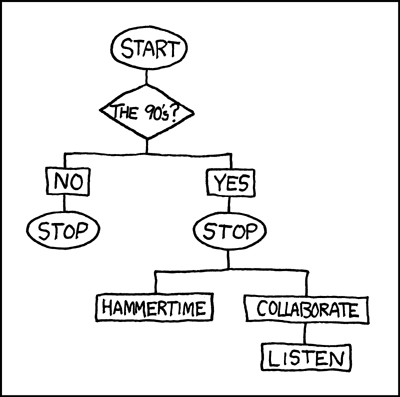
No one was listening when the 90's ended. 10 years later people are voting with their feet and moving their shopping online in droves.
How can you alter this stampede to online retail?
It is as simple as this: Make a decision to stop talking "at" your shoppers and start listening to them as they shop!
Are you wasting your most valuable channel?
Are you ignoring them when they are in your stores?
Apple's Use of EasyPay - Device Convergence is Coming to a Retailer Near You
Apple retail employees are going to be transitioning away from dedicated hardware for purchase transactions (which just happened to be driven by Microsoft software) to an iPhone application called EasyPay.
Podo's roadmap includes device integration with a variety of mobile OS platforms (Symbian, Windows Mobile 7, Bada, etc) so mobile device retailers can use "regular" devices to conduct business. Suddenly an entire layer of cost is being stripped from the process and the shopper experience improves yet again.
Podo's roadmap includes device integration with a variety of mobile OS platforms (Symbian, Windows Mobile 7, Bada, etc) so mobile device retailers can use "regular" devices to conduct business. Suddenly an entire layer of cost is being stripped from the process and the shopper experience improves yet again.
Shopping for Mobile Devices - What the SX Should Be
Orange's is aggressively working toward improving the shopper experience.
Podo began a trial with Orange in May of 2009 to communicate with shoppers about the Nokia N85 phone, videogame downloads, wireless plan options and compatible accessories.
Thus far we've captured thousands of shopper experiences which Orange is able to review via Podo's customer dashboard. They can learn how many shoppers picked up the the mobile phone or interacted with the touchscreen, which games were viewed, how often accessories were viewed, etc.
In-store analytics is only limited by the imagination of the brands and retailers.
Once the retailer has committed to placing a networked device on their retail floor the Shopper Experience begins to morph in exciting ways.
Podo began a trial with Orange in May of 2009 to communicate with shoppers about the Nokia N85 phone, videogame downloads, wireless plan options and compatible accessories.
Thus far we've captured thousands of shopper experiences which Orange is able to review via Podo's customer dashboard. They can learn how many shoppers picked up the the mobile phone or interacted with the touchscreen, which games were viewed, how often accessories were viewed, etc.
In-store analytics is only limited by the imagination of the brands and retailers.
Once the retailer has committed to placing a networked device on their retail floor the Shopper Experience begins to morph in exciting ways.
PODO Technology's Initial Foray into Shopper Experiences
Podo's foundation in SX / UX came from the world of running shoes in 2003.
There are many different gaits and analysis of a runner's movement has a HUGE impact on which shoes are right for the runner's feet.
Shoes are easy. They either work well and you run well or they do not and your feet, knees and back can be painful or even injured. Podo uses a medical device in-store to measure a runner's gait and recommend shoes.
This same process is also present in our mobile device solution.
Shopping is a matter of providing the right information at the right time. When selling shoes a medical device is required to make sure the the "fit" is correct. When selling mobile phones communicating your devices capabilities and functionality to the shopper is imperative.
Today's shoppers are currently FORCED to rely on outdated, printed publications for device comparison in the store - or more likely they simply go home to do research due to the dearth of in-store information.
Make every effort to avoid an injured shopper. It doesn't matter whether you're selling shoes, mobile phones or autmobiles - give the shopper the data needed to make an informed decision! Be sure they get the right device for them every time!
Footwear analysis article explaining the key to a good fit:
Podo video demonstrating our use of these concepts for mobile devices:
There are many different gaits and analysis of a runner's movement has a HUGE impact on which shoes are right for the runner's feet.
Shoes are easy. They either work well and you run well or they do not and your feet, knees and back can be painful or even injured. Podo uses a medical device in-store to measure a runner's gait and recommend shoes.
This same process is also present in our mobile device solution.
Shopping is a matter of providing the right information at the right time. When selling shoes a medical device is required to make sure the the "fit" is correct. When selling mobile phones communicating your devices capabilities and functionality to the shopper is imperative.
Today's shoppers are currently FORCED to rely on outdated, printed publications for device comparison in the store - or more likely they simply go home to do research due to the dearth of in-store information.
Make every effort to avoid an injured shopper. It doesn't matter whether you're selling shoes, mobile phones or autmobiles - give the shopper the data needed to make an informed decision! Be sure they get the right device for them every time!
Footwear analysis article explaining the key to a good fit:
Podo video demonstrating our use of these concepts for mobile devices:
The Chink in Apple's iPhone Armor
The iPhone looked invincible 12 months ago. Suddenly Android is threatening.
Why? Because Google is offering freedom while Apple forces develop jail time.
Is your retail environment prepared to communicate the differences and benefits to your curious shoppers?
Lacking an in-store marketing portal you don't stand a chance.
People like to shop but if they can't get the information they need in the store they'll simply stay home.
Why? Because Google is offering freedom while Apple forces develop jail time.
Is your retail environment prepared to communicate the differences and benefits to your curious shoppers?
Lacking an in-store marketing portal you don't stand a chance.
People like to shop but if they can't get the information they need in the store they'll simply stay home.
Retailing Too Hard - Shopper Experience by Microsoft
This is just painful. Please don't waste more than 30 seconds of your day watching this but sometimes we can better understand what is cool by watching uncool in the making.
In-store Price Checking
Retailers are not prepared for this...
Every shopper can compare prices against the competition down the street.
How are you going to compete when your shoppers know more about your products and prices than you do?
Shopper experience, shopper experience, shopper experience.
If the shopper UX (or is it SX?) doesn't improve dramatically shoppers will have less and less motivation to visit retailers.
How? Whole scale shifting of budgets from dying mediums to in-store is the only solution. Who will lead this charge? A select few agencies who "get it".
Every shopper can compare prices against the competition down the street.
How are you going to compete when your shoppers know more about your products and prices than you do?
Shopper experience, shopper experience, shopper experience.
If the shopper UX (or is it SX?) doesn't improve dramatically shoppers will have less and less motivation to visit retailers.
How? Whole scale shifting of budgets from dying mediums to in-store is the only solution. Who will lead this charge? A select few agencies who "get it".
16.11.09
Future Store Tönisvorst
Podo's mobile device kiosk is used to introduce shoppers to the many technologies (as seen in this video) in use on the retail floor @ the Metro Future Store.
How will you manage?
This is a video compiled by Kronos which points out some important factors regarding employees, workforce, etc.
How does this impact shopper relationships?
There is one other relationship imperative to retail success: employee relationships.
Being able to communicate rapidly, consistently and accurately with your staff is a necessity to build relationships with your team.
In-store networks enable this communication.
Today employees are typically treated (and act) as commodities, not vital parts of the organization. (Hold your offended tongue and spare me the cliche about "our most important asset" - it rings very hollow in retail.)
Engaging your staff is just as important as engaging your shoppers.
How does this impact shopper relationships?
There is one other relationship imperative to retail success: employee relationships.
Being able to communicate rapidly, consistently and accurately with your staff is a necessity to build relationships with your team.
In-store networks enable this communication.
Today employees are typically treated (and act) as commodities, not vital parts of the organization. (Hold your offended tongue and spare me the cliche about "our most important asset" - it rings very hollow in retail.)
Engaging your staff is just as important as engaging your shoppers.
Google Latitude: Location as part of the shopping experience?
What if a shopper could communicate their shopping experience to those nearby?
What if you've just released a cutting edge new product and you want to maximize in-store retail traffic?
Today you advertise. Tomorrow? Your customer's social networks will drive this traffic.
Traditional advertising is already dead. (Though you wouldn't know it by reviewing the brand/agency relationships.)
No one argues whether or not shoppers have relationships - the only question is whether or not the retailer and brands choose to become a part of this fabric.
You won't be let in for free. Relationships cost time, effort, money and love. Show shoppers you want to know them and they will reciprocate in ways you cannot imagine.
What if you've just released a cutting edge new product and you want to maximize in-store retail traffic?
Today you advertise. Tomorrow? Your customer's social networks will drive this traffic.
Traditional advertising is already dead. (Though you wouldn't know it by reviewing the brand/agency relationships.)
No one argues whether or not shoppers have relationships - the only question is whether or not the retailer and brands choose to become a part of this fabric.
You won't be let in for free. Relationships cost time, effort, money and love. Show shoppers you want to know them and they will reciprocate in ways you cannot imagine.
Allow your customers to talk to you while shopping!
Everyone likes giving their opinion.
Ask your shoppers pertinent questions and they WILL answer!
Podo has been communicating via email and SMS with shoppers on the retail floor for over 2 years.
What do shoppers want to tell you about your products and services?
Ask your shoppers pertinent questions and they WILL answer!
Podo has been communicating via email and SMS with shoppers on the retail floor for over 2 years.
What do shoppers want to tell you about your products and services?
Augmented Reality - Where does reality begin and end?
Augmenting reality by overlaying useful information (such as happens with a service such as Yelp) is only the beginning.
But the core difference between these services and professional retail deployments (which will vastly improve the shopper's experience) lie in who is providing the content.
The simplest example: Wikipedia pages are written by users while Corporate Websites are obviously written by the Corporation.
Brick and mortar retailers are in danger of allowing their shopper's augmented reality to be written by shopper's rather than controlling their message themselves. Input from shopper's is inevitable (whether retailers like the feedback being posted or not) but retailers undoubtedly have an opportunity to influence the shopping experience IF they commit to the retail floor as their greatest conduit to the shopper.
Bricks and mortar is THE key differentiator between Online and Offline retail. Yet, rather than embracing their physical relationship with shoppers retailers continue to decimate the shopping experience by focusing on cost-cutting rather than shopper experience.
Today retail efforts could spawn their own FAIL BLOG channel. It should be interesting to see which companies embrace Augmented Reality - which will rapidly become Reality in the financial sense of the word.
In the beginning the internet was ignored creating opportunity for firms such as Amazon. Today retailers have the opportunity to use technology to remind shoppers why they visit physical locations but every shopping season which passes without this embrace is one more generation of shoppers learning to live without buildings.
But the core difference between these services and professional retail deployments (which will vastly improve the shopper's experience) lie in who is providing the content.
The simplest example: Wikipedia pages are written by users while Corporate Websites are obviously written by the Corporation.
Brick and mortar retailers are in danger of allowing their shopper's augmented reality to be written by shopper's rather than controlling their message themselves. Input from shopper's is inevitable (whether retailers like the feedback being posted or not) but retailers undoubtedly have an opportunity to influence the shopping experience IF they commit to the retail floor as their greatest conduit to the shopper.
Bricks and mortar is THE key differentiator between Online and Offline retail. Yet, rather than embracing their physical relationship with shoppers retailers continue to decimate the shopping experience by focusing on cost-cutting rather than shopper experience.
Today retail efforts could spawn their own FAIL BLOG channel. It should be interesting to see which companies embrace Augmented Reality - which will rapidly become Reality in the financial sense of the word.
In the beginning the internet was ignored creating opportunity for firms such as Amazon. Today retailers have the opportunity to use technology to remind shoppers why they visit physical locations but every shopping season which passes without this embrace is one more generation of shoppers learning to live without buildings.
In-store Communication
Retailers are still largely relying on old-style POP displays or human beings to communicate product information to shoppers.
These choices have 2 significant failure points: 1) POP is inflexible and severely limited in its ability to answer shopper questions and 2) employees are simply too expensive to train and maintain on the retail floor.
Enter Point of DECISION terminals.
PODO's solution is not cheap nor easy but it does bridge the "information chasm" on most retail floors.
The attached video is an artist's rendering of some of the concepts PODO has already deployed. (Including a PODO demo unit which is located at the entrance to the Metro Future Store using mobile devices to educate shoppers as they enter the store.)
These choices have 2 significant failure points: 1) POP is inflexible and severely limited in its ability to answer shopper questions and 2) employees are simply too expensive to train and maintain on the retail floor.
Enter Point of DECISION terminals.
PODO's solution is not cheap nor easy but it does bridge the "information chasm" on most retail floors.
The attached video is an artist's rendering of some of the concepts PODO has already deployed. (Including a PODO demo unit which is located at the entrance to the Metro Future Store using mobile devices to educate shoppers as they enter the store.)
13.11.09
Relationships in Real Estate
This is an entire industry which is about to go the way of travel agencies...
Is a day coming when ALL transactions are "For Sale by Owner" simply due to the simplicity of buyer/seller connecting directly? I don't know why not.
I could easily foresee a day when realtors are no longer "relationship managers" as they are today and are more like title/closing clerks. If this occurs you can expect the percentage people are willing to pay to drop by 90% from today's 5-6% commission.
Don't say you weren't warned.
Is a day coming when ALL transactions are "For Sale by Owner" simply due to the simplicity of buyer/seller connecting directly? I don't know why not.
I could easily foresee a day when realtors are no longer "relationship managers" as they are today and are more like title/closing clerks. If this occurs you can expect the percentage people are willing to pay to drop by 90% from today's 5-6% commission.
Don't say you weren't warned.
In-store Game Downloading
Gamestop is pondering in-store game downloading.
Podo has been providing an iteration of this in a trial with a major European wireless firm since May of 2009.
Podo has been providing an iteration of this in a trial with a major European wireless firm since May of 2009.
Nokia's Vision of 2015
While little in this clip is visionary it is an interesting synopsis of some of the fun ways we'll use our mobile devices in the future.
Unfortunately for Nokia every other device manufacturer is chasing the same rainbow and large corporations don't typically excel when it comes to cutting edge development - and yes, this revolution is going to be ALL about the software. (Granted, bad hardware will get you kicked out of the party but software is the only thing which makes you the cool kid.)
Nokia is well aware devices are becoming commodities and software/services will drive the future of interaction (and subsequently revenues/profits.)
It must be a very exciting and also terrifying time at Nokia right now. If anyone at Nokia is walking around arrogantly assuming they have the upper hand in this battle simply due to their resources and marketing machine I would recommend they take a deep breath, swallow their pride, and wonder, just for a moment, "What if we fail?" "What if Android IS embraced?" "What if consumers tire of pretty packages (i.e. E71) which aren't as fast, intuitive and easy and my competitor's devices?"
Is that light you see the end of the tunnel or a train?
Unfortunately for Nokia every other device manufacturer is chasing the same rainbow and large corporations don't typically excel when it comes to cutting edge development - and yes, this revolution is going to be ALL about the software. (Granted, bad hardware will get you kicked out of the party but software is the only thing which makes you the cool kid.)
Nokia is well aware devices are becoming commodities and software/services will drive the future of interaction (and subsequently revenues/profits.)
It must be a very exciting and also terrifying time at Nokia right now. If anyone at Nokia is walking around arrogantly assuming they have the upper hand in this battle simply due to their resources and marketing machine I would recommend they take a deep breath, swallow their pride, and wonder, just for a moment, "What if we fail?" "What if Android IS embraced?" "What if consumers tire of pretty packages (i.e. E71) which aren't as fast, intuitive and easy and my competitor's devices?"
Is that light you see the end of the tunnel or a train?
11.11.09
Agencies Are Aware of the Problem
There is a distinct difference between knowledge and action.
Many firms speak directly to the lack of relationship between retailers, brands and shoppers but bringing these 3 parties together and coming to a joint agreement about revolutionizing in-store marketing is a tall order.
In reality retailers SAY they want to embrace the shopper but they're totally unwilling to spend a nickel to do so. (We've heard their excitement. And we've seen their enthusiasm fade when they find out it isn't free.) They claim otherwise but the lack of commitment in the marketplace argues my case.
The brands? They are so tightly controlled by their agencies innovation is rarely even presented to them.
These comments are not those of a vendor scorned. They are simply the reality of the marketplace. We've had scores of conversations with some of the largest retailers in the world and this theme is persistent. (Though this is understandable as these firms are risk averse and they're simply being asked to venture into unfamiliar territory.)
Shopper relationships, though virtually nonexistent today, are inevitable. Shoppers in the next decade will accept nothing less. Those brands and retailers who pay lip service to this concept will continue to wither. Those with the foresight to embrace current technologies (off the shelf - nothing bleeding edge here) will reap rewards not seen since the advent of television.
Many firms speak directly to the lack of relationship between retailers, brands and shoppers but bringing these 3 parties together and coming to a joint agreement about revolutionizing in-store marketing is a tall order.
In reality retailers SAY they want to embrace the shopper but they're totally unwilling to spend a nickel to do so. (We've heard their excitement. And we've seen their enthusiasm fade when they find out it isn't free.) They claim otherwise but the lack of commitment in the marketplace argues my case.
The brands? They are so tightly controlled by their agencies innovation is rarely even presented to them.
These comments are not those of a vendor scorned. They are simply the reality of the marketplace. We've had scores of conversations with some of the largest retailers in the world and this theme is persistent. (Though this is understandable as these firms are risk averse and they're simply being asked to venture into unfamiliar territory.)
Shopper relationships, though virtually nonexistent today, are inevitable. Shoppers in the next decade will accept nothing less. Those brands and retailers who pay lip service to this concept will continue to wither. Those with the foresight to embrace current technologies (off the shelf - nothing bleeding edge here) will reap rewards not seen since the advent of television.
Will Advertisers and Agencies EVER Learn???
When this video was produced/released a few years ago I was thrilled because it finally shared what everyone in our organization was feeling. Advertisers MUST change the very core of their thought processes and intentions or risk permanently alienating their customers. Fast forward to today and nothing has changed.
The technology to LISTEN to shoppers is available (Podo has been growing in this field rapidly over the past 5 years) but we've not seen wide scale adoption anywhere in the marketplace.
Don't misunderstand - there is plenty of listening going on - but it is being accomplished in arenas where shoppers are already CUSTOMERS (i.e. loyalty/membership programs and online efforts) but 99% of the opportunity is untapped at this point because the retail floor is being ignored.
Retailers are adding screens. Brands are adding screens. All w/ dubious and largely immeasurable effects. Digital signage is NOT listening. It is simply more noise. Interactivity on the retail floor AND the analysis of shopper feedback is the backbone of shopper communication. And communication begets relationship.
When a brand and retailer finally grasp this concept and begin listening to their shopper's desires and interests the ramifications are going to be vast.
The technology to LISTEN to shoppers is available (Podo has been growing in this field rapidly over the past 5 years) but we've not seen wide scale adoption anywhere in the marketplace.
Don't misunderstand - there is plenty of listening going on - but it is being accomplished in arenas where shoppers are already CUSTOMERS (i.e. loyalty/membership programs and online efforts) but 99% of the opportunity is untapped at this point because the retail floor is being ignored.
Retailers are adding screens. Brands are adding screens. All w/ dubious and largely immeasurable effects. Digital signage is NOT listening. It is simply more noise. Interactivity on the retail floor AND the analysis of shopper feedback is the backbone of shopper communication. And communication begets relationship.
When a brand and retailer finally grasp this concept and begin listening to their shopper's desires and interests the ramifications are going to be vast.
Mobile device OS fragmentation continues
Note: Consumer electronics (CE) will be a consistent focus of this blog. Podo's most current solution focuses on this market due to the rapid evolution of devices their immense complexities and the difficulty inherent in marketing such a complex device in a retail environment.
As expected one more mobile device manufacturer has split from the Symbian fold. Nokia has made a valiant effort to distance themselves from Symbian but the risk (perceived or real is immaterial) to other manufacturers is simply too great to absorb.
Major impact of this change? Nokia's marketshare and reputation are slumping while Samsung is growing rapidly. Where are the developers going to head? To the market leader who has a weak/slow lineup of smartphone devices or an up-and-comer? Developers have a tendency to want to avoid entrenched platforms. Time will tell.
As expected one more mobile device manufacturer has split from the Symbian fold. Nokia has made a valiant effort to distance themselves from Symbian but the risk (perceived or real is immaterial) to other manufacturers is simply too great to absorb.
Major impact of this change? Nokia's marketshare and reputation are slumping while Samsung is growing rapidly. Where are the developers going to head? To the market leader who has a weak/slow lineup of smartphone devices or an up-and-comer? Developers have a tendency to want to avoid entrenched platforms. Time will tell.
Geolife
So, Google knows where I am. Get over it. If Jack Bauer calls and suggests you drop off the grid entirely simply sink your phone in acid and disappear. Otherwise, sit back, appreciate and enjoy the new services cropping up every day which are going to make life more interesting.
Relationships? Who (almost) always knows where you are? Your closest friends and family. (Is Google family? Well, not yet - but I suppose if you were an early investor I'm fairly certain you can expect a call from them about your first-born one day.)
Brands and retailers who don't embrace and understand how shopper location is going to impact them are in for a rude awakening.
Relationships? Who (almost) always knows where you are? Your closest friends and family. (Is Google family? Well, not yet - but I suppose if you were an early investor I'm fairly certain you can expect a call from them about your first-born one day.)
Brands and retailers who don't embrace and understand how shopper location is going to impact them are in for a rude awakening.
Avatars vs. Humans
Hmmm... There are humans. And there are avatars. And today there is still a vast difference in the live interaction experience.
Is the business world ready to give up on telepresence meetings and accept avatar meetings instead? My guess would be "no" but with the obvious limitations of bandwidth and cost telepresence isn't going anywhere fast.
Is the business world ready to give up on telepresence meetings and accept avatar meetings instead? My guess would be "no" but with the obvious limitations of bandwidth and cost telepresence isn't going anywhere fast.
Subscribe to:
Posts (Atom)